
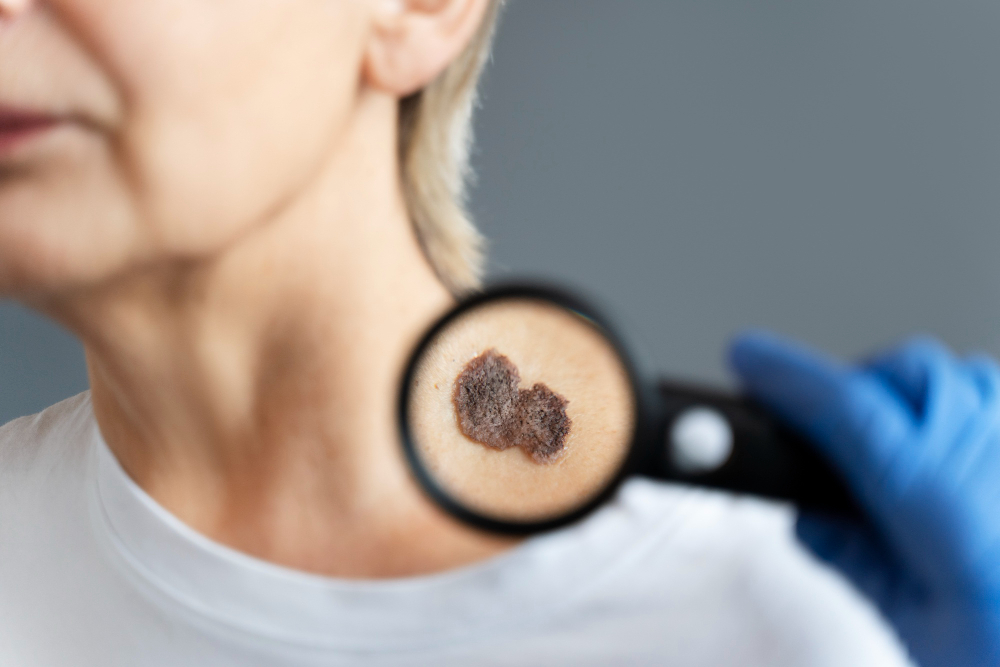
Seborrheic Keratosis Treatment in Clovis & Fresno, CA
Seborrheic keratoses are among the most common benign skin growths seen in adults over 40 — and in the sunny Central Valley, where cumulative sun exposure accelerates their development, they are an everyday part of our practice at Dehesa Dermatology. While seborrheic keratoses are harmless, they can be cosmetically bothersome, itchy, or difficult to distinguish from more serious conditions without professional evaluation. At Dehesa Dermatology, board-certified dermatologist Dr. Luis A. Dehesa provides expert evaluation and removal for patients throughout Clovis, Fresno, and the San Joaquin Valley.
What Is Seborrheic Keratosis?
Seborrheic keratoses (SK) are benign skin growths that arise from keratinocytes — the primary cells of the outer skin layer. They are non-contagious, completely benign, and have no potential to develop into skin cancer. They typically appear as brown, black, or tan raised patches or plaques with a characteristic “stuck-on” appearance, as if they were pasted onto the skin surface. Their surface can be smooth, warty, or crumbly, and they may develop a slightly oily or waxy quality over time.
Seborrheic keratoses most commonly appear after age 40 and tend to increase in number with age — some patients develop dozens or hundreds over their lifetime. They can appear almost anywhere on the body except the palms and soles, but are most common on the trunk, face, shoulders, and neck. While genetics plays a role, sun exposure is a major contributing factor to their development — explaining why they are particularly prevalent among Central Valley residents with decades of cumulative UV exposure.
Despite their benign nature, seborrheic keratoses require professional evaluation to confirm they are not atypical moles, melanoma, or other skin cancers — particularly when a growth has changed in color, size, or texture. Dr. Dehesa uses dermoscopy during skin exams to accurately differentiate SKs from more concerning lesions.
When Should Seborrheic Keratoses Be Removed?
Removal is not medically necessary for confirmed benign seborrheic keratoses, but many patients choose removal for the following reasons:
- Cosmetic concerns — particularly on the face, neck, or other visible areas
- Irritation or itching, especially from friction with clothing or jewelry
- Catching on clothing or becoming inflamed or infected
- Uncertainty about whether a growth is truly benign — prompting removal and biopsy to confirm
Seborrheic Keratosis Removal Options
- Cryotherapy (Liquid Nitrogen): The most commonly used removal method — quick, effective, and requires no anesthesia. The growth freezes and falls off over 1 to 2 weeks. Best for thin, flat, or lightly pigmented SKs.
- Electrodesiccation and Curettage (ED&C): Scraping with a curette followed by electrocautery — highly effective for thicker, raised, or extensively warty SKs. Performed under local anesthesia.
- Shave Excision: Shaving the growth flush with the skin surface under local anesthesia, with the option to submit tissue for pathological analysis if any doubt exists about the diagnosis.
- Laser Treatment: Ablative laser resurfacing for patients with multiple facial SKs, combining removal with overall skin quality improvement. Learn more on our laser treatment page.
Frequently Asked Questions About Seborrheic Keratosis
Is seborrheic keratosis dangerous or cancerous?
No — seborrheic keratosis is a completely benign skin growth with no potential to become cancerous. However, because some SKs can closely resemble melanoma or other skin cancers — particularly when they are darkly pigmented, irregularly shaped, or have changed in appearance — professional evaluation by a board-certified dermatologist like Dr. Dehesa is always recommended before assuming a growth is benign. When in doubt, dermoscopy or biopsy provides definitive reassurance.
Why am I developing so many seborrheic keratoses as I get older?
Seborrheic keratoses are a normal part of skin aging. Their development is influenced by genetics (they run in families) and cumulative sun exposure. In the Central Valley, where residents receive more annual UV exposure than most of the country, it is common to develop large numbers of SKs over a lifetime. While this is completely normal, it does underscore the importance of regular skin exams to ensure that any new or changing growths are promptly evaluated for more serious diagnoses.
Can seborrheic keratoses be prevented?
There is no proven way to prevent seborrheic keratoses, but limiting cumulative sun exposure through daily broad-spectrum sunscreen, sun-protective clothing, and avoidance of peak UV hours may slow their development. Once present, they will not resolve on their own — any removal requires in-office treatment.
Does insurance cover seborrheic keratosis removal?
Removal of seborrheic keratoses is generally considered cosmetic and is not covered by insurance unless the growths are symptomatic (itching, bleeding, becoming infected) or require biopsy to rule out a malignant diagnosis. Our team can discuss coverage and self-pay options with you at your visit. Call (559) 951-9000 for more information.
What is the sign of Leser-Trélat and should I be worried?
The sign of Leser-Trélat is a rare paraneoplastic phenomenon in which a sudden, rapid eruption of numerous new seborrheic keratoses may indicate the presence of an internal malignancy. While this is uncommon and most people who develop many SKs over time do not have an underlying cancer, a sudden explosive appearance of many new SKs warrants evaluation at Dehesa Dermatology to rule out this rare association. Call (559) 951-9000 if you notice a sudden dramatic increase in new skin growths.
Are seborrheic keratoses and actinic keratoses the same thing?
No — they are distinct conditions despite the similar names. Seborrheic keratoses are completely benign growths with no malignant potential. Actinic keratoses are precancerous lesions caused by UV damage that can progress to squamous cell carcinoma if untreated. They can sometimes look similar, which is another reason why professional evaluation is important. Learn more about actinic keratoses on our actinic keratosis page.
Does Dehesa Dermatology remove seborrheic keratoses for patients from Fresno?
Yes. We evaluate and remove seborrheic keratoses for patients from Fresno, Clovis, and throughout the Central Valley. Our office is at 978 N Temperance Ave in Clovis, just minutes from Fresno via Highway 168. Call (559) 951-9000 to schedule your skin evaluation.