
Skin Cancer Screening & Treatment in Clovis & Fresno, CA
Skin cancer is the most common cancer in the United States — more common than all other cancers combined. Yet it is also among the most preventable and treatable when caught early. At Dehesa Dermatology, board-certified dermatologist and Mohs surgeon Dr. Luis A. Dehesa provides comprehensive skin cancer services for patients throughout Clovis, Fresno, and the Central Valley: from full-body screening exams and biopsies to surgical removal, Mohs micrographic surgery, and post-treatment surveillance. In a region with intense year-round sun, proactive skin cancer care is one of the most important investments you can make in your long-term health.
Types of Skin Cancer We Treat
There are three primary types of skin cancer, each arising from different cells in the skin and carrying different risk profiles and treatment considerations:
- Basal Cell Carcinoma (BCC): The most common skin cancer in the United States, accounting for approximately 80% of all skin cancer diagnoses. BCC develops in the basal cells of the epidermis and almost always appears on sun-exposed areas such as the face, scalp, neck, and hands. While BCC grows slowly and rarely spreads to other organs, it can cause significant local destruction and disfigurement if not treated early. Dr. Dehesa is a fellowship-trained Mohs surgeon, making Dehesa Dermatology an ideal destination for BCC treatment in critical anatomical areas. Learn more on our Mohs surgery page.
- Squamous Cell Carcinoma (SCC): The second most common skin cancer, arising from squamous cells in the outer layers of the skin. SCC is more likely to grow deep and spread (metastasize) than BCC, particularly high-risk variants that develop on the ear, lip, in scars, or in immunocompromised patients. Early diagnosis and complete surgical removal are critical. SCC often develops from precancerous actinic keratoses — learn more on our actinic keratosis page.
- Melanoma: The most dangerous form of skin cancer, with a high potential to metastasize if not caught early. Melanoma develops from pigment-producing melanocytes and can arise in existing moles or appear as new growths. Early detection is lifesaving — the 5-year survival rate for stage I melanoma exceeds 98%. Full details on our approach to melanoma are available on our melanoma page.
- Merkel Cell Carcinoma: A rare but aggressive neuroendocrine skin cancer that requires prompt, specialized care and multidisciplinary management.
- Dermatofibrosarcoma Protuberans (DFSP): A rare skin tumor with high local recurrence rates that is treated with Mohs surgery at Dehesa Dermatology for optimal margin control.
Skin Cancer Risk Factors
Anyone can develop skin cancer, but certain factors significantly increase risk — particularly in a high-UV environment like Clovis and Fresno:
- Chronic or cumulative sun exposure, particularly without sun protection
- History of sunburns, especially blistering burns in childhood or adolescence
- Fair skin, light hair, blue or green eyes (less natural UV protection)
- Personal or family history of skin cancer
- Numerous moles or a history of atypical (dysplastic) moles
- Use of tanning beds
- Weakened immune system (organ transplant recipients, HIV, immunosuppressive medications)
- Occupational or recreational outdoor sun exposure (farming, construction, athletics)
- Exposure to radiation or certain chemicals
Skin Cancer Screening at Dehesa Dermatology
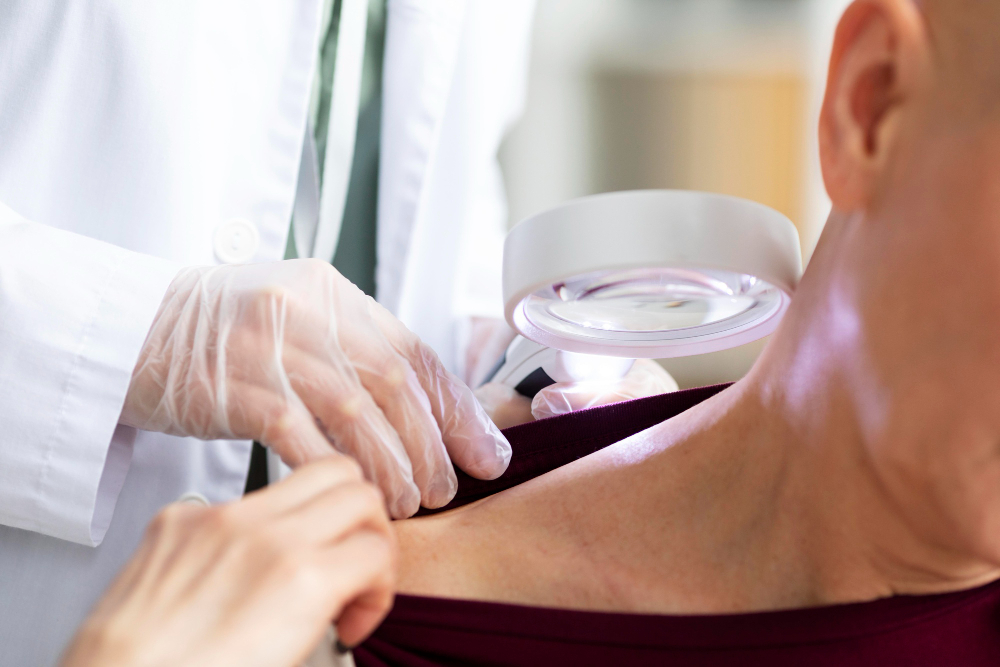
Annual full-body skin examinations are the foundation of skin cancer prevention — and one of the most important appointments you can make if you live in a high-UV region like the Central Valley. During a comprehensive skin exam at Dehesa Dermatology, Dr. Dehesa performs a systematic, head-to-toe examination of all skin surfaces using dermoscopy — a powerful illuminated magnification tool that allows visualization of subsurface structures not visible to the naked eye. Dermoscopy significantly improves the accuracy of skin cancer detection and reduces unnecessary biopsies.
We recommend annual skin exams for all adults, and more frequent monitoring — every 3 to 6 months — for patients with a personal or family history of skin cancer, multiple atypical moles, or other high-risk features. Between appointments, we teach patients how to perform monthly self-skin examinations and what warning signs to watch for.
Skin Cancer Diagnosis
If a suspicious lesion is identified during your exam, Dr. Dehesa will perform an in-office skin biopsy. The biopsy tissue is sent to an independent dermatopathology laboratory for expert microscopic analysis. Results are typically available within 7 to 10 business days. Our team will contact you with results and, if cancer is confirmed, will promptly schedule a follow-up appointment to discuss your treatment plan in detail.
Skin Cancer Treatment Options
Treatment depends on the type, size, location, and stage of the skin cancer, as well as the patient’s overall health and individual preferences. At Dehesa Dermatology, our treatment options include:
- Mohs Micrographic Surgery: The gold standard for basal cell and squamous cell carcinomas on the face, scalp, neck, and other anatomically critical or high-risk locations. Achieves cure rates up to 99%. Dr. Dehesa is a fellowship-trained Mohs surgeon. Full details on our Mohs surgery page.
- Standard Excision: Surgical removal of skin cancers on the trunk, extremities, or other areas where Mohs is not indicated. Performed under local anesthesia with suture closure.
- Electrodesiccation and Curettage (ED&C): Scraping and burning technique appropriate for select low-risk, superficial skin cancers.
- Topical Chemotherapy: Imiquimod or 5-fluorouracil cream for select superficial basal cell carcinomas or for patients who are not surgical candidates.
- Radiation Therapy: Coordination with radiation oncology for patients who cannot undergo surgery or as adjuvant treatment for advanced tumors.
- Systemic Therapy and Oncology Referral: For advanced, metastatic, or immunotherapy-appropriate cases, we coordinate referral to oncology specialists while continuing to co-manage the dermatologic aspects of care.
Frequently Asked Questions About Skin Cancer
How often should I get a skin cancer screening?
For most adults, annual full-body skin exams are recommended. Patients with a personal history of skin cancer, multiple atypical moles, or strong family history of skin cancer should be seen every 3 to 6 months. Residents of high-sun-exposure areas like Clovis and Fresno are especially encouraged to establish an annual dermatology relationship. Call (559) 951-9000 to schedule your skin check at Dehesa Dermatology.
What does skin cancer look like?
Skin cancer appearances vary by type. Basal cell carcinoma often looks like a pearly or waxy bump, a flat flesh-colored or brown scar-like lesion, or a bleeding sore that heals and returns. Squamous cell carcinoma typically appears as a firm red nodule, a flat lesion with a scaly, crusted surface, or a new sore or raised area on an old scar. Melanoma is characterized by the ABCDEs — see our melanoma page for a detailed description. Any new or changing growth should be evaluated promptly.
Is skin cancer hereditary?
Genetics play a role in skin cancer risk. A family history of melanoma, in particular, significantly increases your personal risk. Multiple family members with skin cancer, or a personal history of skin cancer, warrants earlier and more frequent screenings. Some rare genetic syndromes (such as Gorlin syndrome or xeroderma pigmentosum) carry very high skin cancer risks and require specialized management. At Dehesa Dermatology, we assess family history as part of every comprehensive skin evaluation.
What happens after my skin cancer is removed?
After surgical removal, you will receive detailed wound care instructions and a follow-up appointment to check healing and review final pathology if pending. Once cancer is confirmed cleared, we establish a surveillance schedule — typically every 6 to 12 months for the first few years — to monitor for recurrence at the treated site and check for new skin cancers elsewhere on the body. Patients with a history of skin cancer have a significantly elevated risk of developing additional skin cancers, making ongoing surveillance essential.
Can skin cancer be prevented?
While skin cancer cannot always be completely prevented, the risk can be dramatically reduced through consistent sun protection practices: daily broad-spectrum SPF 30+ sunscreen, sun-protective clothing, avoidance of peak UV hours between 10 a.m. and 4 p.m., wearing wide-brimmed hats outdoors, and never using tanning beds. Regular annual skin exams at Dehesa Dermatology are the most effective way to catch any skin cancers that do develop at the earliest, most treatable stage.
Is skin cancer more common in Fresno and Clovis than other parts of California?
The Central Valley receives significantly more annual sun exposure than coastal California cities, with over 270 sunny days per year and high UV index readings throughout the warm months. Combined with common outdoor occupations and recreational activities in the region, this makes Fresno and Clovis residents particularly vulnerable to cumulative UV damage and skin cancer. At Dehesa Dermatology, we understand the specific sun exposure patterns of our community and provide care tailored to the unique needs of Central Valley patients.
Do you treat skin cancer patients from Fresno?
Absolutely. We serve patients from Fresno, Clovis, and throughout the Central Valley for skin cancer screening, biopsy, and treatment including Mohs surgery. Dr. Dehesa is one of the most experienced dermatologist-Mohs surgeons in the region, with deep ties to the Fresno medical community through his years as a Clinical Professor of Dermatology at UCSF Fresno. Our office at 978 N Temperance Ave in Clovis is accessible from Fresno via Highway 168. Call (559) 951-9000 to schedule your exam.