
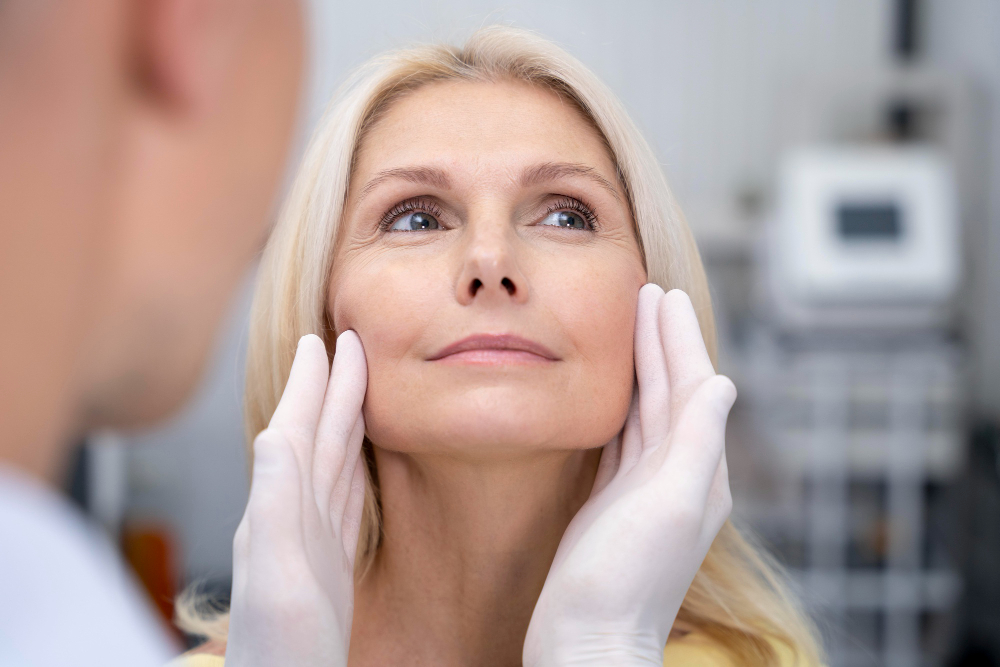
Facelift Surgery
The face changes in predictable ways over time — skin loses elasticity, fat redistributes, and the jawline softens into jowls. A facelift, or rhytidectomy, addresses these changes at their source rather than masking them. At Dehesa Dermatology, our board-certified plastic surgeon performs individualized facelift procedures designed to restore a naturally youthful contour without the tight, pulled appearance that older techniques sometimes produced. The result is a refreshed version of you — not a different face.
If you’ve been considering a facelift and want to understand what’s possible for your specific concerns, a one-on-one consultation is the right first step.
What a Facelift Treats
A facelift targets the mid-face, lower face, and neck — the areas where gravity and volume loss tend to have the most visible impact. Common concerns that a facelift effectively addresses include:
- Jowls and loss of jawline definition
- Deep nasolabial folds (smile lines)
- Sagging cheeks and midface descent
- Loose, banded, or excess skin along the neck
- Hollowing under the eyes and in the cheeks
A facelift does not address forehead lines, crow’s feet, or the area around the eyes — those concerns are better treated with a brow lift or blepharoplasty, which can be performed at the same time if appropriate for your goals.
Modern Facelift Techniques
SMAS Facelift
The SMAS (superficial musculoaponeurotic system) facelift is the gold standard for comprehensive facial rejuvenation. Rather than simply pulling the skin tighter, this technique repositions the deeper muscle and connective tissue layer beneath the skin — which is what actually shifts with age. By lifting at the SMAS layer, your surgeon achieves more natural, longer-lasting results with less tension on the skin itself. Scars are placed discreetly within the hairline and around the ear where they are minimally visible at rest.
Deep Plane Facelift
The deep plane technique releases and repositions the facial tissues at an even deeper level than a standard SMAS lift, making it particularly effective for patients with significant midface descent, deep nasolabial folds, or more advanced facial aging. It produces pronounced, natural-looking improvement and is especially well suited to patients who want the most durable result possible from a single procedure.
Mini Facelift
For patients in their 40s or early 50s with early-to-moderate facial aging and good skin elasticity, a mini facelift offers meaningful improvement through smaller incisions and a shorter recovery. It addresses early jowling and mild neck laxity without the full scope of a traditional facelift — and can serve as an excellent preventive procedure for patients not yet ready for a more extensive surgery.
What to Expect: From Consultation to Recovery
Your facelift journey at Dehesa Dermatology begins with a thorough consultation in which your surgeon evaluates your facial anatomy, reviews your medical history, and listens carefully to your goals. Together, you’ll determine which technique is most appropriate and whether any complementary procedures — such as fat grafting, blepharoplasty, or injectable treatments — would enhance your overall result.
Facelift surgery is performed under general anesthesia or deep sedation and typically takes two to four hours depending on the technique and any concurrent procedures. Most patients return home the same day. Initial swelling and bruising peak in the first week and resolve significantly by weeks two to three, with final results visible at around three months as residual swelling fully settles. Most patients return to work and social activities within two to three weeks.
The results of a well-performed facelift typically last eight to twelve years, and many patients choose to maintain their result with non-surgical treatments in the years following their procedure.
Facelift Combined with Other Procedures
A facelift addresses the lower two-thirds of the face, but many patients achieve their best overall result by combining it with complementary procedures performed during the same surgical session. Common pairings include brow lift for forehead and brow position, blepharoplasty for the upper and lower eyelids, fat grafting to restore lost volume in the cheeks and temples, and laser resurfacing to improve skin texture and tone. Combining procedures reduces total recovery time compared to staging them separately and allows your surgeon to address the face as a unified whole.
Frequently Asked Questions About Facelift Surgery
Am I a good candidate for a facelift?
Good candidates are generally in their 40s through 70s, are in good overall health, do not smoke, and have realistic expectations about what surgery can achieve. The most important factor is the degree and distribution of your facial aging — your surgeon will assess this at your consultation and let you know whether a facelift, a less invasive procedure, or a combination approach is the right fit for your goals.
Will my results look natural?
Modern facelift techniques — particularly SMAS and deep plane approaches — are designed specifically to avoid the “pulled” or “done” appearance associated with older methods. By repositioning tissue rather than just tightening skin, today’s facelifts produce results that look like a rested, younger version of you rather than a surgically altered face. The goal is always to restore, not to transform.
Where are the scars located?
Facelift incisions are placed within the natural contours of the ear — running along the front edge of the ear, around the earlobe, and behind the ear into the lower hairline. When healed, the scars are well concealed by the ear itself and the natural hairline. Most patients find their scars essentially invisible within a few months of surgery, particularly with proper scar care.
How long does a facelift last?
A well-performed facelift typically maintains its results for eight to twelve years, after which many patients choose to have a secondary or “revision” facelift. The aging process continues after surgery, but you will always look younger than you would have without the procedure. Skin care, sun protection, and maintenance treatments can extend the longevity of your results significantly.
What is the recovery timeline?
Most patients experience swelling and bruising for one to two weeks following surgery. The majority of visible bruising resolves by week two, and patients typically feel comfortable returning to work and light social activities within two to three weeks. Strenuous physical activity is restricted for four to six weeks. Final results are visible at approximately three months as residual swelling fully settles.
Can a facelift be combined with non-surgical treatments?
Yes — and for many patients, this is the most effective approach. A facelift corrects structural laxity and excess skin, while injectables like Botox and dermal fillers address dynamic lines, fine wrinkles, and subtle volume needs that surgery doesn’t target. Many patients maintain their facelift results over the years with periodic non-surgical treatments. Your surgeon can advise on the best combination for your specific anatomy and goals.
Is a facelift performed under general anesthesia?
Most facelift procedures at Dehesa Dermatology are performed under general anesthesia or monitored anesthesia care (MAC) for your comfort and safety. The choice of anesthesia is determined based on the extent of the procedure and your individual health history. Our team coordinates with board-certified anesthesiologists to ensure your safety and comfort throughout the procedure.