
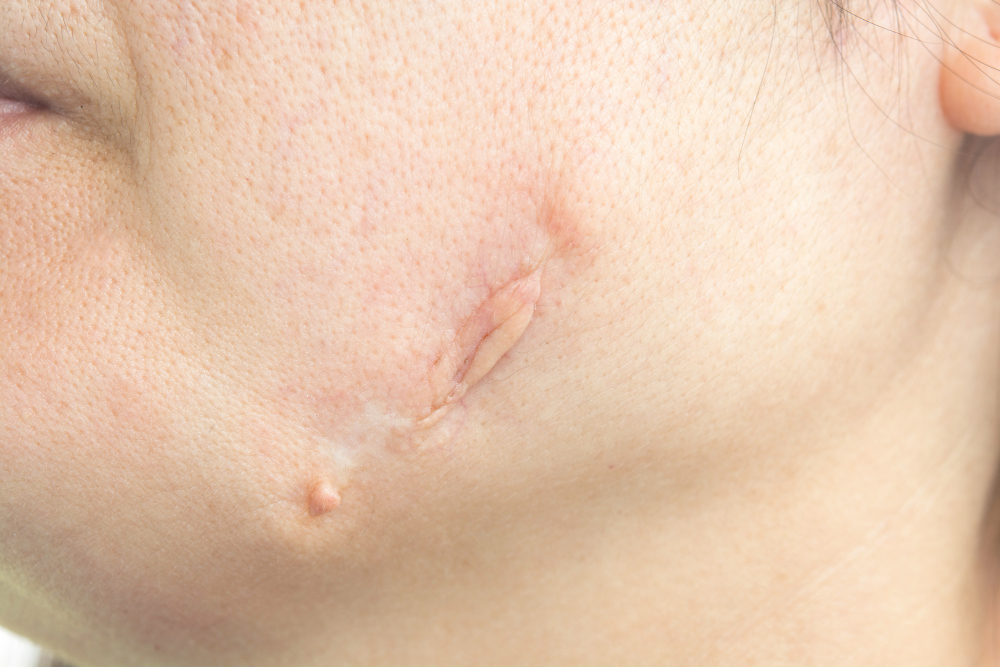
Scar Revision Surgery
Scars are a natural part of healing — but not all scars heal the same way, and some become a persistent source of physical discomfort, self-consciousness, or functional limitation. Scar revision encompasses a range of surgical and non-surgical techniques designed to improve the appearance, texture, color, and function of existing scars. At Dehesa Dermatology, we evaluate each scar as an individual problem and develop a targeted treatment plan based on its type, location, age, and the patient’s own healing characteristics. The goal is not to erase a scar — no treatment can do that — but to make it as inconspicuous and comfortable as possible.
If a scar is affecting your quality of life or confidence, schedule a consultation to learn which approach is most appropriate for your situation.
Types of Scars We Treat
Hypertrophic Scars
Hypertrophic scars are raised, firm, and often red or pink scars that remain within the boundaries of the original wound. They develop when the body produces excess collagen during healing — commonly after burns, surgical incisions, or traumatic injuries. Unlike keloids, hypertrophic scars may improve on their own over time but can remain prominent for years without intervention. They respond well to steroid injections, laser treatment, and surgical revision depending on their size, location, and duration.
Keloid Scars
Keloids are overgrown scars that extend beyond the original wound margins into the surrounding healthy skin. They are more common in patients with darker skin tones and often have a genetic component. Keloids can be itchy, tender, and continue to enlarge over time. Treatment typically combines surgical excision with adjunctive therapy — such as corticosteroid injections, silicone sheeting, or radiation therapy — to reduce the risk of recurrence. Management of keloid scars requires a careful, staged approach and realistic expectations about long-term outcomes.
Contracture Scars
Contracture scars develop when a large area of skin is lost or damaged — most often from a burn — and the healing tissue tightens and constricts the skin. Contractures can restrict movement, limit range of motion across joints, and cause significant functional impairment in addition to their cosmetic impact. Surgical correction typically involves releasing the contracted scar tissue and replacing it with healthy skin through skin grafting or local tissue rearrangement techniques such as Z-plasty or W-plasty.
Depressed or Atrophic Scars
Atrophic scars sit below the level of the surrounding skin and result from a loss of tissue or collagen in the healing process. Acne scars are a common example, as are certain traumatic scars and scars from chicken pox. Depending on their depth and distribution, atrophic scars may be improved through subcision, dermal fillers, laser resurfacing, microneedling, or surgical excision and re-closure with precise technique.
Stretched or Widened Scars
Scars in high-tension areas — such as across joints, over the chest, or along the abdomen — are prone to stretching and widening as they mature. These scars are typically flat but become wide, pale, and conspicuous over time. Surgical revision with proper tension management, layered closure, and orientation adjustment can significantly narrow and improve these scars, particularly when they occur in visible areas.
Scar Revision Techniques
The right treatment approach depends entirely on the type of scar and the patient’s goals. At Dehesa Dermatology, we use a combination of techniques tailored to each individual case.
- Surgical excision and re-closure — removing the scar and reclosing with meticulous layered technique to produce a finer, better-oriented scar
- Z-plasty and W-plasty — geometric rearrangements that break up a linear scar, redirect tension, and improve scar position relative to natural skin lines
- Skin grafting — transplanting healthy skin from another area of the body to replace damaged or contracted tissue
- Laser resurfacing — ablative and non-ablative lasers to improve color, texture, and surface irregularity
- Corticosteroid injections — reducing thickness and firmness in hypertrophic and keloid scars
- Dermabrasion and microneedling — mechanical resurfacing techniques to blend scar edges with surrounding skin
- Silicone sheeting and pressure therapy — non-surgical management options appropriate for early or superficial scars
Realistic Expectations for Scar Revision
Scar revision can produce dramatic improvement — particularly for scars in unfavorable locations, scars with poor orientation relative to the skin’s natural tension lines, or scars that healed with pigmentation changes, contour irregularities, or excess bulk. However, no treatment eliminates a scar entirely. The goal is always to improve: to make the scar less visible, less symptomatic, and more compatible with normal daily life. Your surgeon will give you an honest assessment of what improvement is realistic for your specific scar before any treatment begins.
Frequently Asked Questions About Scar Revision
How do I know if my scar is ready for revision?
Most surgeons recommend waiting at least twelve months after the original wound or surgery before pursuing scar revision, as scars continue to mature and improve on their own during this time. However, there are exceptions — scars causing functional impairment, significant contracture, or located in cosmetically prominent areas may warrant earlier evaluation. A consultation will help determine whether your scar has reached the appropriate stage for intervention.
Can all scars be improved with revision?
Most scars can be meaningfully improved, but the degree of improvement varies depending on the scar type, location, patient age, skin tone, and individual healing response. Some scars respond dramatically to a single procedure, while others — particularly keloids — require a staged, multi-modality approach with ongoing management. Your surgeon will give you an honest, realistic picture of expected improvement at your consultation rather than overpromising outcomes.
Will scar revision create a new scar?
Surgical scar revision does involve making new incisions, which means a new scar will form. The goal is to produce a scar that is significantly less visible than the original — finer, better oriented, and positioned more favorably within the natural skin lines. In experienced hands, the trade is almost always worthwhile, but your surgeon will walk you through exactly what to expect from the revision incisions before proceeding.
How many treatments are typically needed?
This varies considerably by scar type. Some scars improve significantly after a single surgical revision. Others — particularly hypertrophic or keloid scars — benefit from a combination approach over multiple sessions, such as surgery followed by steroid injections and laser therapy. Your surgeon will outline a realistic treatment roadmap at your consultation and adjust the plan based on how your scar responds to initial treatment.
Is scar revision covered by insurance?
Insurance coverage for scar revision depends on whether the scar causes functional impairment or is the result of a covered medical event. Scars that restrict joint movement, impair vision, or result from reconstructive surgery following trauma or cancer treatment may qualify for coverage. Purely cosmetic scar revision is generally not covered. Our team can review your situation and help you understand your coverage options prior to scheduling any procedure.
What can I do to support the best healing after scar revision?
Following surgery, diligent scar care is essential to achieving the best outcome. This typically includes keeping the scar out of the sun and using high-SPF sunscreen consistently, applying silicone gel or sheeting as directed, avoiding smoking throughout the healing period, and attending all follow-up appointments so your surgeon can monitor progress and intervene early if the scar shows signs of widening or thickening. Adherence to post-operative instructions has a significant impact on the final result.