
Cyst & Lipoma Removal in Clovis & Fresno, CA
Lumps and bumps beneath the skin are among the most common reasons patients come to see us at Dehesa Dermatology — and while the vast majority are completely benign, they deserve professional evaluation to confirm their nature and determine whether removal is appropriate. At Dehesa Dermatology, board-certified dermatologist Dr. Luis A. Dehesa provides expert evaluation and in-office removal of skin cysts, lipomas, and other benign skin tumors for patients throughout Clovis, Fresno, and the Central Valley — with precise surgical technique, minimal scarring, and careful attention to cosmetic outcomes.
What Are Skin Cysts?
Skin cysts are closed, fluid-filled or semi-solid sacs that develop within the skin. They are lined by a cyst wall (epithelium) that continuously produces the cyst’s contents — meaning they will typically grow over time and will not resolve on their own. The most common types seen at Dehesa Dermatology include:
- Epidermal Inclusion Cysts (EIC): The most common type of skin cyst, also called epidermoid cysts or sebaceous cysts (a common misnomer — true sebaceous cysts are rare). These are firm, round, moveable nodules with a visible central punctum. They contain cheesy, malodorous keratin material and occur most commonly on the face, neck, trunk, and behind the ears. EICs can become inflamed or infected, at which point they become red, tender, and may rupture — a situation requiring prompt treatment.
- Pilar Cysts (Trichilemmal Cysts): Similar in appearance to EICs but arising from the outer root sheath of the hair follicle. Occur almost exclusively on the scalp. Have a thicker wall than EICs and can reach significant size. Run strongly in families.
- Milia: Tiny, white, superficial epidermal cysts commonly found around the eyes, cheeks, and nose. More cosmetically than medically significant. Can be treated with extraction by our esthetician team or with a small needle in the office. Learn more on our esthetician page.
- Digital Mucous Cysts: Fluid-filled cysts that develop on the finger near the nail fold, often associated with underlying osteoarthritis of the joint. Can cause nail deformity if located near the nail matrix.
- Ganglion Cysts: Fluid-filled cysts arising from a joint or tendon sheath, most commonly on the wrist or hand. While managed primarily by orthopedics, dermatologic evaluation helps confirm the diagnosis.
What Are Lipomas?
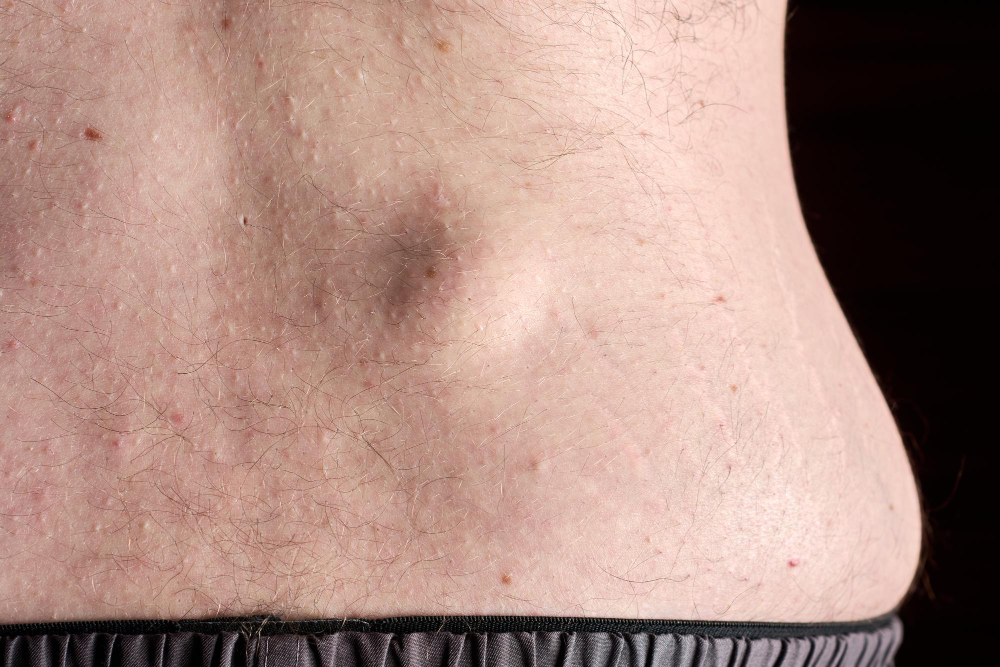
Lipomas are benign tumors composed of mature fat cells. They are the most common soft tissue tumor in adults — present in approximately 1 in 100 people — and occur most frequently on the trunk, shoulders, upper back, upper arms, neck, and thighs. Lipomas are soft, rubbery, moveable, and non-tender under the skin. They grow slowly over years and rarely cause significant symptoms, though larger lipomas can occasionally become bothersome due to size, pressure, or cosmetic concerns.
While lipomas are overwhelmingly benign, any rapidly growing, firm, deep, or painful subcutaneous mass warrants professional evaluation to rule out liposarcoma or other more concerning diagnoses. Dr. Dehesa evaluates all skin masses carefully before planning any intervention.
Cyst and Lipoma Removal at Dehesa Dermatology
Removal of cysts and lipomas at Dehesa Dermatology is performed as an in-office surgical procedure under local anesthesia. Key aspects of our approach:
- Cyst Excision: Complete removal of the cyst sac (cyst wall) is essential for preventing recurrence. Simple drainage or incision without wall removal results in a high rate of recurrence. Dr. Dehesa removes the entire cyst intact whenever possible, using a technique that minimizes scarring. The incision is closed with sutures and the patient returns for suture removal 1 to 2 weeks later.
- Inflamed Cyst Management: Inflamed or infected cysts are managed differently from non-inflamed cysts. Active infection may require a two-stage approach — drainage and antibiotic treatment first, followed by complete excision once inflammation has resolved — to minimize surgical complications and recurrence risk.
- Lipoma Excision: Small to medium lipomas are removed through a small incision that is planned to minimize visible scarring. The lipoma is delivered through the incision and the capsule is removed to minimize recurrence. For larger or deeper lipomas, our collaboration with plastic surgeon Dr. Duncan MacKay is available for more complex cases.
- Pathological Submission: All excised cysts and lipomas can be submitted for pathological examination to confirm the diagnosis, which our team recommends for any lesion with atypical features on clinical evaluation.
Frequently Asked Questions About Cysts and Lipomas
Should I have my skin cyst removed?
Removal is not always medically necessary for a confirmed benign cyst. However, we typically recommend removal if the cyst is growing, has become inflamed or infected, is causing discomfort, or is cosmetically bothersome. Small, stable, asymptomatic cysts can be monitored at your annual skin exam. The advantage of elective removal when a cyst is calm and uninfected is a simpler, cleaner procedure with a better cosmetic outcome than urgent removal of an inflamed cyst.
Can a skin cyst go away on its own?
Skin cysts do not typically resolve on their own because the cyst wall continuously produces new contents. A cyst may temporarily decrease in size if it ruptures, but it will almost always refill and often become larger and more inflamed after rupture. The only reliable way to eliminate a cyst permanently is complete surgical excision of the cyst wall.
What happens if a cyst gets infected?
An infected or inflamed cyst becomes red, warm, painful, and sometimes ruptures spontaneously. This requires prompt treatment at Dehesa Dermatology. Depending on severity, treatment may include incision and drainage, oral antibiotics, or intralesional steroid injection for early inflammation. Complete excision is then planned after the infection has fully resolved — typically 4 to 6 weeks later — to achieve the best possible cosmetic result and lowest recurrence risk. Call (559) 951-9000 promptly if you notice signs of cyst infection.
Is a lipoma dangerous?
The vast majority of lipomas are completely benign and require no treatment beyond confirmation of the diagnosis. However, any subcutaneous mass that is rapidly growing, firm or hard rather than soft, painful, deep, fixed to underlying structures, or larger than 5 cm should be promptly evaluated to rule out liposarcoma. At Dehesa Dermatology, Dr. Dehesa performs a thorough clinical evaluation — and refers for imaging or further workup when any concerning features are identified.
Will cyst or lipoma removal leave a scar?
All surgical procedures leave some degree of scarring. Dr. Dehesa plans incisions carefully — taking into account the location, skin tension lines, and cosmetic sensitivity of the area — to achieve the smallest, least visible scar possible. For cosmetically sensitive areas such as the face, neck, or chest, our collaboration with plastic surgeon Dr. Duncan MacKay is available for more complex reconstruction. Post-procedure scar management guidance is provided to all patients to optimize healing outcomes.
Does insurance cover cyst and lipoma removal?
Coverage depends on your insurance plan and the clinical circumstances. Removal of inflamed, infected, or symptomatic cysts is often covered as medically necessary. Removal of asymptomatic cysts or lipomas for purely cosmetic reasons is typically not covered. Our team reviews your specific situation and insurance requirements at your consultation and provides documentation to support coverage when clinically justified. Call (559) 951-9000 for more information.
Does Dehesa Dermatology remove cysts and lipomas for patients from Fresno?
Yes. We perform in-office cyst and lipoma removal for patients from Fresno, Clovis, and throughout the Central Valley. Our office is at 978 N Temperance Ave in Clovis, accessible from Fresno via Highway 168. Call (559) 951-9000 to schedule your evaluation and removal consultation.